

Due to Budget 2026, the BSE and NSE have announced that the stock market will open on February 1. The timings are as follows.
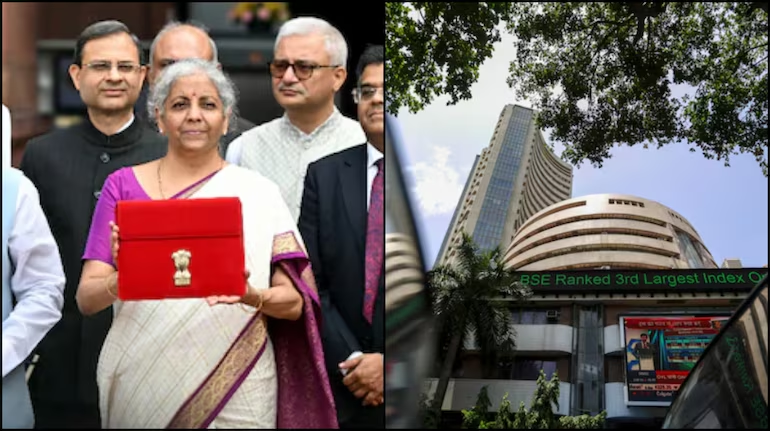
The stock exchanges declared that the day’s program will follow regular hours.
“On account of the presentation of the Union Budget, members are requested to note that Exchange shall be conducting live trading session on February 01, 2026, as per the standard market timings (9:15 am-3:30 pm),” stated the NSE in a circular.
The Speaker of the Lok Sabha announced on January 12 that the Union Budget for 2026 will be delivered on Sunday, February 1, at 11 a.m.
In recent years, the annual budget exercise has taken place on February 1st. On February 1, the Union Budget for 2025 was also unveiled.
Finance Minister Nirmala Sitharaman will give the Union Budget for the ninth time in a row with the 2026 Budget, making it one of the longest unbroken tenures of a finance minister.
The Economic Survey will be released by the Ministry of Finance before to the Budget, and top officials including Chief Economic Advisor (CEA) V. Anantha Nageswaran will thereafter have a news conference.
The enormous task of document preparation is carried out by the finance ministry’s Department of Economic Affairs. An yearly activity, the Union Budget displays the state of the government’s finances in terms of projected profits and expenses. Additionally, it is a document that highlights new financial ideas and schemes that the Center hopes to implement in the next fiscal year. Recall that markets were kept open for budget releases on Saturday, February 1, 2025, Saturday, February 1, 2020, and Saturday, February 28, 2015.

Expectations for the 2026 budget
Investors and tax professionals are advocating for improvements to India’s capital gains tax system as Budget 2026 draws near. Reduced Long Term Capital Gain (LTCG) rates, low STT, increased exemption ceilings, consistent holding periods across asset classes, and the reinstatement of indexation advantages are some of the main requests.
They contend that such actions are essential to lowering tax burdens, safeguarding long-term savers, and maintaining investor confidence. The rising taxes have been bemoaned by brokers, investors, AMCs, and market players, who claim that they deter long-term investment. Furthermore, market analysts lamented the hefty taxes eroding the meager returns during a volatile fiscal year.